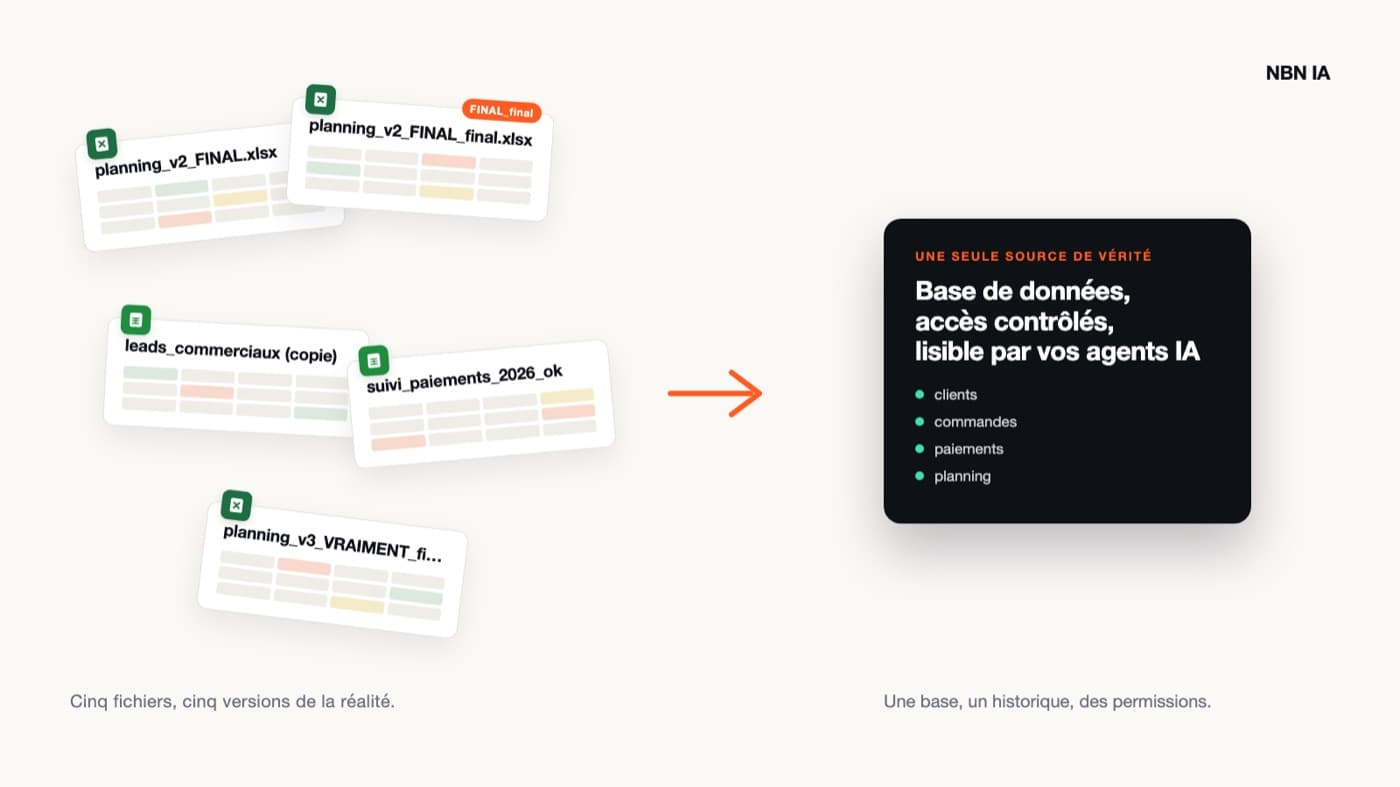
Somewhere in your company there is a file called “planning_v2_FINAL_final.xlsx”. Everyone knows it. Nobody is quite sure it's the right version. And yet the whole team keeps updating it, each on their own, hoping it doesn't fall apart.
This isn't an edge case. It's the norm in most small businesses.
The spreadsheet: universal solution, universal problem
Excel and Google Sheets have a rare quality: they adapt to anything. A schedule, a customer list, simplified bookkeeping, a makeshift CRM, inventory, a project timeline — everything ends up in a spreadsheet, because it's fast, free, and everyone more or less knows how to use one.
The problem isn't the tool. It's what happens when nobody sets clear rules for how it's used. After a few months, a typical small business ends up with:
- one Sheet for sales leads
- another for payment tracking
- a third one, shared by mistake with the wrong person, for team schedules
- formulas only one person understands, and that person just went on holiday
- duplicated data across several files that never talk to each other
Every file becomes a silo. Every silo requires mental gymnastics to know where to look, which version is current, and who is allowed to touch it. You're no longer managing data; you're managing a collection of files that contradict each other.
The real cost is mental load
The real cost of this setup is easy to underestimate. It's not the price of a licence. It's the time lost looking for the right version, copying information from one file to another, fixing a typo that has been sitting there for three weeks.
It's also a direct brake on everything AI can do today. An intelligent assistant or an automation agent needs reliable data, reachable through a single door, to be genuinely useful.
One important clarification: the problem isn't the file format itself. A clean Google Sheet, with a clear structure, a single source of truth and controlled access, can perfectly well be read and used by an AI — through an API, an automation, an agent. What blocks everything isn't “Excel”, it's the lack of discipline: five files each telling a different version of reality, and nobody able to say which one is right.
What AI (and tools like Supabase) changes
What's new isn't the idea of having a real database instead of a badly kept spreadsheet — businesses have known that for a long time. What's new is that it has become accessible without tying up a team of developers for months.
Tools like Supabase let you set up a structured database, with clear rules about who can read or change what, far faster than a classic development approach. And above all, that database can be wired directly to AI tools. An agent can query it, update an order, answer a customer, generate a report — without anyone having to open a file to check a figure by hand.
Let's be honest about the flip side: a poorly designed database, with no thought given to its structure, can recreate exactly the same chaos as a messy spreadsheet. Technology doesn't replace rigour — it just makes rigour easier to put in place and to maintain over time.
The real shift comes down to a few concrete points:
- A single source of truth, instead of several files each telling a different story
- Real permissions, rather than a shared link where everyone can change everything
- Data an AI can use, able to answer a question or trigger an action automatically
- A traceable history, rather than file versions overwriting each other
The real obstacle isn't technical
The technology to structure your data properly exists, it's mature, and it's no longer reserved for large companies. The real obstacle, most of the time, is habit. Those mental workarounds you've absorbed without noticing: “I know where to look”, “I know how to get around the formula bug”, “I know who has the right version”.
That habit is reassuring because it's familiar. But it has a real cost, and it limits what AI can actually bring to the business. You can't plug an intelligent agent into a system that only exists in the head of the person who built the file.
So the question isn't “Excel or database”. It's: does my data have a single, clean, accessible source of truth — whatever tool holds it?
Changing how you store your data isn't a technical whim. It's a precondition for AI to become genuinely useful in a business, rather than a gadget tested on one isolated case while the core of the activity keeps running on files sent by email.
The good news: you don't have to rebuild everything at once. The transition can happen gradually, one flow at a time, starting with the data that causes the most trouble today.